
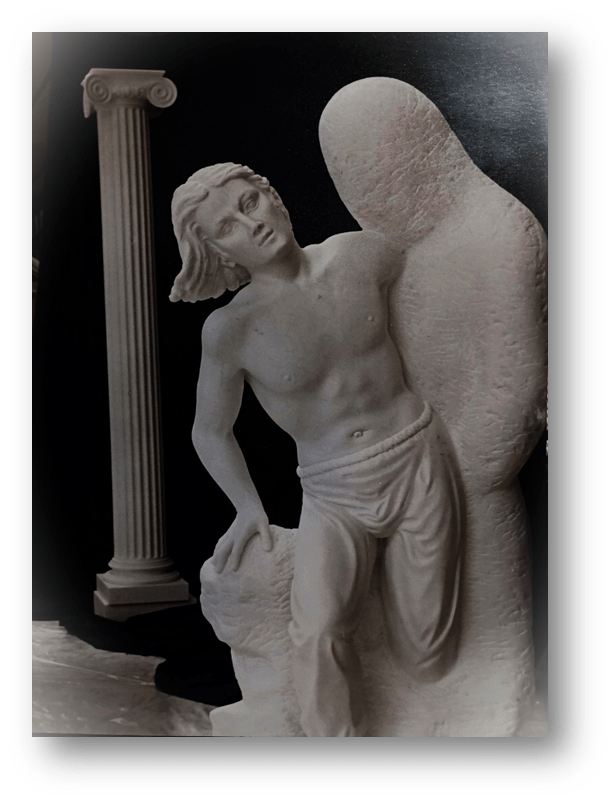
Sembrava una forma scolpita nella luce,
ma era la vita, che non avevamo saputo vedere.
“Precious is sleep, better to be of stone, while the oppression and the shame still last; not seeing and not hearing, I am blest; so do not wake me, hush! keep your voice down”,[1] these are the lyrics of Michelangelo about his statue the Night, the sleeping, voluptuous woman who evokes admiration, while at the same time, through the state of sleep, it reflects the melancholy of the great artist due to the collapse of freedom with the prevalence of the tyranny of the Medici.[2]
The above poetic and at the same time highly philosophical words of Michelangelo bring to the surface the ambiguity of the sculpted body: it is made of stone, that is, of matter that is not governed by the vitality of feeling, but a matter that, as it is sculpted, becomes incarnate from the moment it imprints the matter of the existential experienced body. The sculpture does not hear, nor see, but it reveals a body that hears, that sees, that feels.
The matter of marble is transformed into incarnate matter, displaying the form of the existence it depicts. The relationship between matter (Hyle) and form (Morphe) that activates the alternation of potentiality and energy is highlighted through Aristotelian thought. For Aristotle, the material is “potentially” a statue. When the material is sculpted and takes the form of the statue, then the purpose of the material, the final cause, is accomplished. Aristotle believed that every technical skill and activity, as well as every act and choice, aims at some final cause, which for the philosopher is the good, the goal of all things. There is, however, a difference, Aristotle points out in the Nicomachean Ethics , proceeding to distinguish actions in themselves from the result of actions, namely entelechy.
If, therefore, there is an end to all actions, an end that we desire for its own sake, without pursuing it for the sake of something else, then, according to Aristotelian philosophy, this end is the good, and indeed the supreme good, since the corresponding action is not motivated by an appetite that lacks content (“For as in the art of sculpture and in all crafts and in all work and action virtue is to work with good judgment, so in man virtue is”). [3]
Sculpture, then, is the final cause, it is the purpose that is identified with the supreme good, and specifically with the good of beauty, since the purpose of sculpture as Fine Art, but also of all Fine Art, is beauty. If there is an art that reveals beauty as such by touching the boundary between the sensible and the intelligible, it is sculpture. Within the marble, not only a form is embodied, but the idea — the immaterial that acquires flesh. There, in the stillness of the statue, a tension is revealed: between what is seen and what is.
Sculpture brings to the surface the beauty of human existence by projecting the human body itself as a harmonious whole. Beauty was associated with the proportion and harmony of both the soul and the body, starting from Pythagorean philosophy and Plato’s Timaeus where the harmonious proportion of the soul of the body with the movements of the universe is highlighted, [4]as well as modern and contemporary philosophical thought.
This particularity of sculpture that makes all three dimensions of existential corporeality visible has attracted the interest of great philosophers such as Winckelmann and Hegel to deal with sculpture both in terms of its essence and in terms of its sense as Fine Art. Winckelmann , the father of the aesthetics of beauty, wrote that in ancient Greek sculpture “beauty expresses freedom.” It is not simply about symmetry or proportion; it is about the spirit that is shaped, the soul that clothes the body.[5]
Hegel , deeply influenced by Winckelmann, goes deeper: in sculpture, the spirit finds its first external, material, but free expression. The statue, for Hegel, is not just a work of art – it is the point where the absolute spirit touches the world of the senses, without losing itself. It is not an imitation of nature, but a sculpting of man as spirit embodied . The statue is where Being recognizes itself in matter.
The form, sculpted and perfect, is not exhausted by beauty. As Hegel observes, it reveals a truth : that of man as spirit in the body, nature imbued with meaning. The statuary body of the god or hero does not represent a person, but the ideal itself , individualized and at the same time eternal. Therefore, in order to reach the truth, one must traverse a path of stations – forms ( Gestalten ) that lead from darkness to conscious sensitivity, from the truth of hic and nunc in the absolute truth that permeates time and radiates into eternity.[6]
If for Winckelmann sculpture was the field where the ideal became visible, and for Hegel the first moment of expression of spiritual freedom, for the other very important philosopher of the 20th century , Adorno , art—and sculpture in particular—now faces another task: to bear witness to the unspeakable . Especially after the 20th century, after Auschwitz, the alienation, the massification of culture, the work of art cannot “decorate” the world.
The statue , in this new aesthetic and moral framework, is no longer the ideal hero nor the divine mind embodied. It is a broken body , a wounded form. It is the resistance of matter to idealization. Its rigidity is not perfection, but the hardness of the wound that cannot be articulated in words.
Adorno sees in the silence of statues a dialectic of negation: art can no longer speak “positively”, but through resignation, through a form that refuses to console. The sculpture becomes an empty form, but precisely for that reason honest. The art of sculpture thus becomes a condition for the emergence of the real within which subjectivity can overcome its limitation, giving form to thought, embodying inspiration. As Adorno argued , identity is the power of non-identity. The power of non-identity is revealed in the form of the statue in whose three-dimensional form non-identity or a potential identity becomes visible.[7]
The statue thus becomes a teacher of the gaze . It stands there not simply for us to look at, but to make us see flesh differently , not as material, but as a carrier of meaning. The body not as a tool, but as an event of Being . And the spirit — as something that once lived, and within the marble continues to pulsate. Sculpture, then, is not an art of the past. It is always present. For whenever we sculpt the form, we seek again what we are: a spirit that longs to be seen, to be heard — to take form. In late modernity, beauty is no longer sculpted. The incomprehensible is sculpted.
Adorno warns us: any art that pretends that the world is harmonious is false. In this sense, sculpture must sculpt pain, mirror the crack, reveal the violence of silence. And yet, in this silence, a new kind of beauty emerges: not of symmetry, but of endurance. Not of perfection, but of truth that refuses to be forgotten.
The statue is not only an aesthetic object, it is the passage of the spirit through matter, the testimony of a moment of inspiration that became form. In the thought of one of the founders of 20th century phenomenology , Martin Heidegger , sculpture brings into existence a space, not simply metric, but ontological — an “opening” through which Being is perceived. Thus, the statue is nothing but the trace of truth in marble form — a stillness that moves contemplation. Heidegger saw in the statue the constitution of place: a spatial-ontological opening where Being is revealed. [8]The statue seems immobile, but it never remains stationary, nor is it there simply as a volume that occupies space. The form of the sculpture governs space and expands it as a place of Being while shifting the viewer from external time to the internal question: What is human? What is freedom when it takes form?
This form, which is revealed as existence is thrown into life, is not a finished form, but is constantly in development, as the individual is in a constant effort to activate the possibilities of his corporeality. As Merleau-Ponty wrote, “the body is the power of a certain world” — it is not an object, but a work of art in progress, through which existence inhabits the world.
The body is not an object, but a subject of a relationship, and when it becomes the object of sculpture, it is not only represented, but is embodied and incarnates. The statue is not simply a form, but the very phenomenon of embodied consciousness, as it understands itself within Being. Sculpture thus becomes the pre-eminent site of incarnation: the moment when inspiration, the immaterial, passes into flesh, without ever fully identifying with it. The flesh that is sculpted reveals. The work of art is not representation, but the event of manifestation.
Aesthetic corporealities capture the existential body at the moment when the suddenness of inspiration as an experience of immateriality reveals the form of the material, transforming it into incarnate matter. The evolutionary path of the body as a work of art from the potential of matter to the perfection of form highlights the body’s endless potential for creation, verifying the words of the great and intuitive philosopher Maurice – Merleau Ponty , according to whom the body is more like a work of art than an object of the physical order. [9]
The existential body is revealed as an open horizon of life from the moment the form is not accomplished, but is constantly on an evolutionary path of activating vital potentialities. Every human body, then, is nothing but a gesture towards itself — a silent accomplishment of Being, where matter is set ablaze by the intensity of the unspeakable. There is no body without a history, no form without a rupture. The body speaks without saying, stands without holding an answer, becomes a space of transition between the manifest and the unmanifest.
In this pulsating region between form and silence, art finds its own rhythm. And perhaps no other artistic discourse captures this silence of the body as deeply as sculpture. There, the body does not move — but speaks in its pause. The touch of matter is not a simple imitation; it is the transmutation of an inner tension into form, the imprint of a gaze, a resignation, an absence. This is precisely the existential climate one encounters in the work of the contemporary sculptor Anthimos Altitzoglou. Anthimos does not seek the perfection of representation; he seeks the moment of change, the crack in the body from which consciousness emerges. His forms are not static — even in their stillness they are in action. They are bodies that do not pose, but bodies that remember, endure, address. There, in the quiet spot between address and silence, corporeality is inscribed not as an image, but as an existential act.
In one of his most characteristic works (see image at the beginning of the text), Anthimos Altitzoglou presents the figure of a young man, standing and naked, who embodies the form itself, or rather the form that manages to escape from the mold, that faceless, amorphous figure that silently rises behind him, regaining freedom. This figure has no face; it resembles a presence without identity, a body without form, and yet its silence weighs more heavily than the realism of the body in front.
The young man’s gaze is not directed towards the viewer, nor towards the shadow that accompanies him. He is withdrawn, introverted, as if carrying a memory or an unspoken burden. His body, although realistic, does not claim heroism; it is fragile, exposed, and his posture suggests a man who does not scream, but endures.
The shapeless form behind it is more than a background: it is the past self or the future; the memory or the shadow of trauma; the repressed or the divine. It is there, as a silent threat or a hidden protection. And the human body, at this point of contact, is no longer just a body — it is the tension between being and surrendering.
The work does not represent an event; it is itself an existential event, a visual event that carries within it the impossibility of modern man to be whole, to live authentically as he is trapped in the mold of a falsely inscribed well-groomed prosperity. Altitzoglou does not make statues; he creates moments of revelation — where the body, without speaking, acts, and the form, without being completed, signifies. It is a silent performativity, where every turn of the shoulder, every tilt of the head, every concealment or abstraction, does not belong simply to aesthetics, but to the philosophy of existence.
Beauty is revealed as the embodiment of freedom in the sculptural body of Altitzoglou’s work. The physical materiality of his sculpture is an experienced materiality. The members of the sculptural body do not function only prosthetically, nor are they reduced to something in an abstract sense. Bodily intentionality[10]stems from the vital determination that governs the existential body of the statue as an entity of movement and sensation. The body is the power of a certain world, as Maurice – Merleau writes Ponty in the Phenomenology of Perception , and movements – the manifestations of this power of the body to break free from the shackles of its limitation.
Anthimos does not simply sculpt a body — he reveals to us the experience of corporeality. The statue stands as a being that remembers; its body bends, leans, surrenders to an invisible story.
The sculpted body in the art of Anthimos Altitzoglou is not simply composed of marble; it is composed of matter that remembers. The form of the young man does not convey anatomical perfection, but the body’s memory of itself. And this memory, as with every human being, carries trauma — not necessarily as a wound, but as a low substratum of silence, something that persists, underground, behind every presence.
The abstract form behind the new has a double semantics: it symbolizes not only an aesthetic counterweight, but also the matter of trauma, that which never acquired form, because it could never be said. It is the half-forgotten, the silenced, the unspeakable — where consciousness did not reach, or could not bear to reach. This matter is voluminous, featureless, almost mute — and yet it stands there, like a memory that was never narrated.
This encounter between form and formlessness, between a body that is exposed and a mass that is silent, creates a dynamic of density and suspense. Form, Aristotle would say, is the end of matter; the becoming of something that it is destined to be. But here, in Anthimus, form does not dominate—it coexists with the possibility of non-form. Trauma, as an existential sediment, refuses to crystallize.
Thus, the work functions as a presence of memory within matter. A memory that is not verbal, not reducible to history, but inscribed in the very posture of the body: in the retreat of the neck, in the inertia of the limbs, in the distance between them. It is not a representation of the trauma, but its embodied manifestation as a weakness of form.
Here too, the sculptor is not a creator of perfection. He is a witness to lack. He does not make form out of nothing; he listens to the material, gropes where it resists taking shape, and there he lets his work fall silent with it. The material becomes the carrier of the unsaid, and the form an accomplice to this silence.
In the work of Anthimos Altitzoglou, the body is not a complete object; it is an interrupted continuity, a relief that pulsates between form and decomposition. Between the realistic surface and the amorphous mass that frames it, a void opens up — not simply as a physical space, but as an existential rift.
The void is not outside of us. It permeates us. It is inscribed in the body like trauma: not as something added, but as something missing and therefore defining. It is the point where speech stops, the gaze retreats, and form does not know whether to continue to be form or to dissolve into the silence of matter.
At this point, Altitzoglou’s sculpture captures something radically human: our deep affinity with the formless, with the unspeakable that lives within us not as a contradiction but as a condition of dialectic. The statue does not complete itself; it leaves open a core of silence, a gap, that persists.
There, the void is not the absence of life; it is the point where life is interrupted to be felt, it does not threaten; it establishes.Τhis void does not govern multiplicity as a definitive and finished principle, but constantly intensifies the disposition of human existence to transcend its futility.
The void that runs through the body is not a metaphysical void—it is the very gap between what we are and what we can perceive ourselves to be. Merleau-Ponty offers us two languages for this gap: the corps propre and the corps vécu, the body as we live it, as we inhabit it from within, with sensations, pulses, and insecurities.
Anthimos Altitzoglou, without “contemplating” the body, contemplates it through its form . The young man standing in his work is a corps propre [11]—a body that is seen, that is exposed to light and the gaze. His posture, the inclination of his body, the bending of his gaze, the strange closeness to the formless creature that touches him—all this does not describe an exclusively objective body; it testifies to a body that lives itself. A corps vécu, [12]that remembers, suffers, foreshadows, is silent.
There, in the internal fluctuation of the body, between action and absorption, intention and passivity, what we might call a void is born — not as a distance between having and being a body, but as distorted time : the crack where the body, while being, hesitates to emerge . The young man stands in this very crack. It is a body that acts and feels at the same time; it is the one that moves and the one that allows silence to penetrate it . Not separated between two bodies, but embodying the intensity of the same body that sometimes projects and sometimes folds . It is the body as decision and as deprivation, as gesture and as holding. The formless presence behind it perhaps embodies the delay of experience , the experience that was not completed, that remained pending, without language . It is not another body — it is the same body in its shadow . It is that part of the self that does not inhabit the world intentionally, but exists as a weight, as a sediment, as a silent materiality . It is the time inscribed in the embodied memory without being transformed into speech. It is not a distinction between the corps vécu and the corps-objet , but an embodied dialectic : the body that is at once that which feels and that which cannot bear to feel completely.
Thus, the work is not simply a sculptural performance; it is a condition of existence that tells us: the body is never one. It is gaping, performed, dual — and the void that permeates it is the precise point where the self is born.
And perhaps, ultimately, what Anthimos Altitzoglou is dealing with is not simply form or matter, but the passage. The passage from the formless to form, from the body to the experience, from gravity to meaning — from the dark rustle of nonexistence to the moment of light that the body struggles to bring.
The body that bends, that leans, that touches its shadow, does not surrender. The body is dying — not towards death, but through death, as if trying to break its cocoon, to tear that thin, transparent veil that separates the still-alive from the already-lost. As if attempting, for an infinitesimal moment, to stand in nothingness and not dissolve.
His anguish is not a cry; it is an experience of climax—where the body reaches the limit of its own potential and does not retreat. It is the performativity of silence; not of spectacle, but of the inner act, that which carves the form from the inside out.
Altitzoglou’s work carries this core moment: a figure that does not represent death, but touches it without bending. And next to it — or within it — the void. Not as an error, but as a womb. Not as an end, but as a moving limit.
Perhaps this is ultimately the form: the trace of man in the agony of time, the matter that, even for a moment, refuses to be completely silent. A body born from trauma, a shape that survives the struggle with nothingness.
Abbiamo creduto fosse luce,
ma era la vita, come non potevamo reggerla.
BIBLIOGRAPHY
GREEK
- Αριστοτέλης, Ηθικά Νικομάχεια, ( Aristotle, Nicomachean Ethics), Μετάφραση Σχόλια: Δημήτριος Λυπουρλής, Publishing: Εκδόσεις Ζήτρος, 2006, Θεσσαλονίκη. Γι’ αυτή την έκδοση : ΤΟ ΒΗΜΑ/ ΑΛΤΕΡ ΕΓΚΟ Α.Ε., 2020.
- Τσουκαλά, Κ., σχέσεις σωμάτων και αρχιτεκτονική, εκδ. ΕΠΙΚΕΝΤΡΟ Α.Ε., Publishing House, Thessaloniki, 2023.
FOREIGN LANGUAGE/ TRANSFORMED
- Adorno, WT, Aesthetic Theory (Ästhetische Theorie Ed. Gretel Adorno and Rolf Tiedemann. Frankfurt am Main: Suhrkamp Verlag, 1970), copyright 1997 by the University of Minnesota Press, 1997, [e-book, published 2020], https://www.google.gr/books/edition/Aesthetic_Theory/VQzoDwAAQBAJ?hl=el&gbpv=1 retrieved (25/7/2025).
- Hegel’s Lectures on Aesthetics , Part 3, Section II, “Sculpture” retrieved (26/7/2025) https://www.marxists.org/reference/archive/hegel/works/ae/part3-section2.htm#sculpture .
- Mitchell, A., Heidegger Among the Sculptors Body, Space, and the Art of Dwelling, Stanford University Press, California, 2010, [e-book], retrieved from: https://www.google.gr/books/edition/Heidegger_Among_the_Sculptors/fUWwgO1Vg0MC?hl=el&gbpv=0 (25/7/2025).
- Ponty, M.M., Φαινομενολογία της Αντίληψης , ( Phenomenologie de la perception ), ( trans . Kiki Kapsampeli ), published by Nisos , 2016, Athens (Gallimard, 1945).
- Rizzatti, M. L. , [Volume on Michelangelo] , series:. “I Grandi di Tutti i Tempi”, (Οι Μεγάλοι όλων των Εποχών), Arnoldo Mondadori Editore SpA, Milan, 1965, for the Greek language: ΟΡΓΑΝΙΣΜΟΣ ΕΥΡΩΠΑΪΚΏΝ ΕΚΔΟΣΕΩΝ Ε.Ε».
OTHER SOURCES
- Michelangelo Buonarroti, Complete Poems and Selected Letters, https://www.goodreads.com/quotes/408777-precious-is-sleep-better-to-be-of-stone-while-the retrieved : 27/7/2025.
- https://www.eefshp.org/johann-joachim-winckelmann-propatoras-ton-eyropaion-filellinon-ymnodos-tis-ellinikis-aisthitikis-kai-dianoitikis-katharotitas/ retrieved 25/7/2025.
- https://husserl.net/ retrieved 27/7/2025.
[1] Michelangelo Buonarroti, Complete Poems and Selected Letters, https://www.goodreads.com/quotes/408777-precious-is-sleep-better-to-be-of-stone-while–theretrieved : 27/7/2025.
[2]See Maria Luisa Rizzatti, [Volume on Michelangelo] , series: “I Grandi di Tutti i Tempi”, (Οι Μεγάλοι όλων των Εποχών), Arnoldo Mondadori Editore SpA, Milan, 1965, for the Greek language: ΟΡΓΑΝΙΣΜΟΣ ΕΥΡΩΠΑΪΚΏΝ ΕΚΔΟΣΕΩΝ Ε.Ε», p. 49.
[3] Αριστοτέλης, Ηθικά Νικομάχεια, ( Aristotle, Nicomachean Ethics), Μετάφραση – Σχόλια: Δημήτριος Λυπουρλής, Publishing: Εκδόσεις Ζήτρος, 2006, Θεσσαλονίκη. Γι’ αυτή την έκδοση : ΤΟ ΒΗΜΑ/ ΑΛΤΕΡ ΕΓΚΟ Α.Ε., 2020,Α’ 7, 1098a7–10.
[4]Κυριακή Τσουκαλά, σχέσεις σωμάτων και αρχιτεκτονική, εκδ. ΕΠΙΚΕΝΤΡΟ Α.Ε., Publishing House, Thessaloniki, 2023, 3.1, pp. 57-58.
[5] https://www.eefshp.org/johann-joachim-winckelmann-propatoras-ton-eyropaion-filellinon-ymnodos-tis-ellinikis-aisthitikis-kai-dianoitikis-katharotitas/ retrieved 25/7/2025.
[6] Hegel’s Lectures on Aesthetics , Part 3, Section II, “Sculpture” retrieved (26/7/2025) https://www.marxists.org/reference/archive/hegel/works/ae/part3-section2.htm#sculpture
[7]Theodor W. Adorno, Aesthetic Theory (Ästhetische Theorie Ed. Gretel Adorno and Rolf Tiedemann. Frankfurt am Main: Suhrkamp Verlag, 1970), copyright 1997 by the University of Minnesota Press, 1997, [e-book, published 2020], https://www.google.gr/books/edition/Aesthetic_Theory/VQzoDwAAQBAJ?hl=el&gbpv=1 retrieved (25/7/2025).
[8] Andrew Mitchell, Heidegger Among the Sculptors Body, Space, and the Art of Dwelling, Stanford University Press, California, 2010, [e-book], retrieved from: https://www.google.gr/books/edition/Heidegger_Among_the_Sculptors/fUWwgO1Vg0MC?hl=el&gbpv=0 (25/7/2025).
[9] Maurice Merleau- Ponty, Φαινομενολογία της Αντίληψης, ( Phenomenologie de la perception Gallimard , 1945), published for Greek Language by Νήσος, 2016, Athens , Part 1 , IV , p. 270.
[10] https://husserl.net/
[11] Maurice Merleau – Ponty , Φαινομενολογία της Αντίληψης, ( Phenomenologie de the perception, Gallimard , 1945), (trans. Κική Καψαμπέλη), published by Νήσος, 2016, Athens.
[12]Regards, Maurice Merleau – Ponty .