


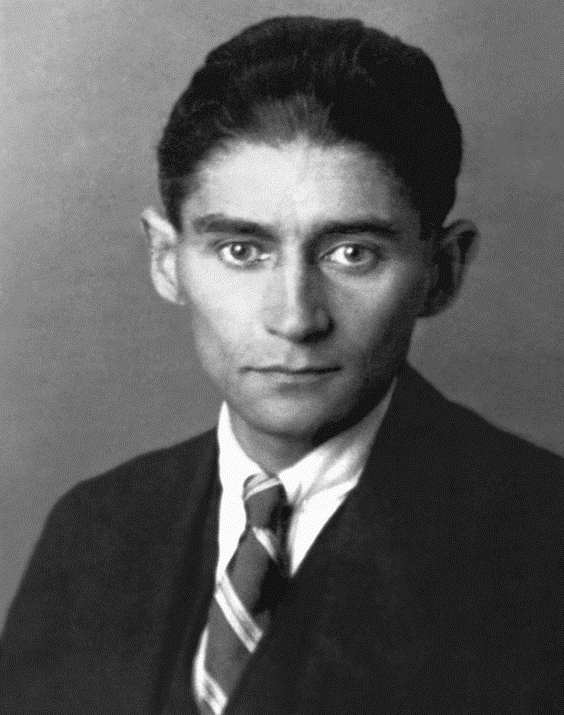
Life as the primal source of inspiration, and writing as a psychobiological act of existential revolt.
Franz Kafka, one of the most intuitive writers, a thinker of his time relevant in every era, having penetrated human existence foreseeing its evolutionary unpredictability. Kafka was born on July 3, 1883 in Prague, Czech Republic to German-speaking Jewish parents. He was the first child in the family, after the early death of two younger boys, an only child for six years, until the birth of his sister Gabriele.1
His father was highly conservative, authoritarian, a source of stress for Kafka. His father never stopped scorning and tyrannizing him. Kafka’s childhood and youth were marked by a conflicted relationship with his father whom he respected, admired and at the same time hated, as can be seen from the autobiographical “Letter to Father“, written in 1919.2
Kafka attended German schools, while in 1901 he transferred to the German University in Prague. He initially enrolled in the Chemistry Department, but quickly found that he was not succeeding and, finally, followed Law.3 From an early age he had expressed his spiritual concerns and introspective nature. He loved reading a lot, and from his first high school years he had started writing theatrical “sketches” for his sisters, who presented them at their parents’ parties. He started writing short stories from 1889, of which, however, he destroyed most of them, because they did not satisfy him.4
Kafka worries about the nerve-wracking issues of human existence, as well as human existence itself as such within a reality of unpredictable risk. In 1914, World War I broke out. Kafka lived through World War I, although due to his civil service status he was not listed. In the entries of that horrific prelude to the even greater horror of World War II in his Diaries and Blue Octavo Notebooks the references to war are terse: “War,” “Recovery,” “Peace.”5
Although some scholars argue that the brevity of his words regarding the war is due to the fact that he did not participate in the war himself, we could say that his brevity is more due to the fact that he abhorred all forms of violence, cruelty and oppression, since he himself as a child experienced oppression by his father, finding refuge in writing which functioned for him as a psychobiological revolution, as an impetus towards freedom and life. Kafka uses a simple vocabulary referring to the war to demonstrate the existential poverty and deprivation of the human being who experiences war conflicts either as an instigator or as a victim. These conditions cannot be described with cosmetic adjectives and rich words, but in one word, with strict sparing.
Another important event in his life that marked him and motivated him existentially to express his inspiration through the power of writing, was his meeting with Milena Jesenska Polak. From this acquaintance a love was born and a correspondence and a book (Letters to Milena) resulted.
On September 4, 1917 he was diagnosed, after a series of incorrect medical opinions, with tuberculosis and took sick leave from his job, he stopped keeping a diary in large notebooks and started writing in small blue notebooks (as the title suggests).6 In these notebooks, he no longer writes about everyday issues, but almost exclusively reflections that express his desire to penetrate into the depths of human existence.
Its inspiration and expressive form works refreshingly for the author. His expression of inspiration through creative writing unfolds as a sculpture of disappointments, such as the failure of his relationship with Felice Bauer reflected in his masterpiece The Trial, written in 1914, or his relationship with Milena Jesenska Polak which prompted the creation of his other great work, the Castle.7
Kafka’s last short stories are connected to his life together with Dora Diamant, his last lover, as well as his agonizing attempt to realize the seriousness of his illness and come to terms with it, as seen in his 1923 play The Burrow.8 His relationship with Dora was the only fact that gave him joy in his life. She had a positive effect on his repressed personality, even helping him to shake off the shackles of his oppressive family and live with her for a year in Berlin. He returned to Prague just three months before his death, on June 3, 1924.9
Through literary reflection, Kafka finds a way out of the impasse of existence, unraveling anxieties, guilt, as he penetrates into the deeper causes of modern man’s alienation, which is embodied in the existential body, as seen in his work Metamorfosis written in 1912 . The Metamorfosis is the story of an ordinary man, Gregor Samsa, who wakes up one morning transformed into an insect.10 This transformation constitutes an allegorical way in which Kafka attempts to demonstrate the modalities of alteration of human existence, which, cut off from the self, from the natural and the human itself, transforms into something completely foreign, while being trapped in the shackles of the domestic and timely authoritative bio-system.
In this work, Kafka demonstrates the transformation of space, time and of course the existential body within space-time that exists and endures bio-political authoritarianism in every manifestation of life. Space-time and the existential body are fermented with the events inscribed by the violences of bio-power and oppression. The bio-political oppression that governs the contemporary hic et nunc inscribes itself on human corporality, breaking the relationship of image-body with shape-body, at the moment it stops the development of its sensorimotor perception.
Gregor Samsa wakes up and realizes that his body has transformed into the body of an insect, his movements are made with difficulty, his legs are thin and have lost their flexibility, every attempt to move is accompanied by intense pain. All he could do was crawl, which shows the condition of modern man being a prisoner of the imperious complexity within social becoming.
In Metamorfosis oppression does not only become inactive in its social dimension, but also the more personal dimension, that is, the oppression that the author experienced within his family environment. His bitterness, but also the fact that he was suffocating can be seen in many places in the work in question, such as the point where Gregor Samsa expresses his discomfort with his job stating that if it were not for the issue of his parents in the middle he would have resigned for a long time. Throughout the work, the existential suffocation he felt, the anxiety, the anguish, and at the same time a form of compulsive respect towards his parents combined with fear is evident. In fact, through his allegorical transformation, he expresses his complaint and anguish because he did not receive acceptance from his mother. He writes, therefore, that his mother was not used to his form as an insect, implying that in essence he never felt her acceptance. Fear and discomfort intertwine in a complex way and create the feeling of guilt in the author, who expresses it heartbreakingly in Metamorfosis. His parents are not used to his new status as an insect, reacting with hysterics and overreactions, just as he was trying to accept his new body, which he felt a relative physical well-being and was ready to overcome by daring his first steps. Through these allegorical images it seems that his family rejected and discouraged any kind of effort that the author attempted to achieve his goals.
His body is his strength, the expression of his vital readiness and determination. Kafka approaches the hero’s corporality in a heartbreakingly phenomenological way, emphasizing his sensuous motor potential and vital readiness. Through Kafka’s work the flesh does not emerge as a mechanistic mass, but as a totality of complex possibilities. Bodily materiality is a lived materiality that expresses, as it unfolds within the world, the anxieties, fears, and guilts of human existence as it oscillates amid alterations and hybridizations of evil. The members of the body do not function only prosthetically, contributing exclusively to the formation of beings, nor are they reduced to something absolutely mental in an abstract sense. Bodily intentionality (Husserl) emanates from the vital determination that governs the existential body as an entity of movement and sensation. The hero tries, he does not give up the effort of movement, despite his failures and pain. He crawls, but struggles to stand on his feet and slowly but surely take his first steps, wanting to free himself from all this suffocating space-time condition to which his transformed body has been subjected.
The body is the power of a certain world, as Maurice-Merleau Ponty writes in the Phenomenology of Perception, and the movements are the manifestations of this power. The hero is his body, which constitutes a vinculum between his Being and the world. Bodily spatiality (l’espace corporel) is coextensive with Being-in-the-world (l’être-au-monde) as it opens sensumotorically as intersubjectivity in its intracosmic horizon.11
The flesh (corporéité)12 as lived materiality unfolds as a spacious and temporal whole expressing the modalities of its dialectic as image-body and as schema-body that simultaneously embodies the human and the physical, time and space, thought and language13, as it extends through bodily and ontological movements that unequivocally declare the innate tendency of human existence towards freedom.
The sensorimotor proprioception of the body is not only expressed as a harmonized mobility of the members, but also as a neuro-linguistic mobility harmonized with the existential bodily whole, since speech is a vital process that evolves simultaneously with thought, because it does not translate an already ready thought, but fulfills it, as Merleau Ponty believed.14 In Metamorfosis, Gregor, who inhabits the body of an insect, has not lost his ability to speak, but those around him do not understand a word of what he was saying, even though his words sounded absolutely clear to him, even clearer than before – maybe because his ears were used to it.
This paradox of embodiment—where the lived body becomes both the site of expressive freedom and of existential opacity—opens the way to a deeper interrogation of the body not merely as a biological entity, but as a field of phenomenological experience and political inscription. As Gregor’s experience shows, the breakdown of recognition between self and other, language and meaning, reflects a broader alienation inscribed upon the flesh itself. It is to this interstice—where phenomenology meets the political—that we now turn, to explore the body as both witness and battleground of human freedom and estrangement.
- Franz Kafka, Τα Οκτώ Μπλε Τετράδια, (Die Acht Oktavhefte), μτφρ. Ερατώ Τριανταφυλλίδη, εκδ. Αρχέτυπο, Θεσσαλονίκη, Preface, p.4. ↩︎
- Franz Kafka, Η μεταμόρφωση (Die Verwandlung), translated by: Μαργαρίτα Ζαχαριάδου, 1st edition in German: Kurt Wolff, Leipzig, 1915, this edition (20th ): εκδόσεις Πατάκη, Αθήνα, Νοέμβριος 2023, Preface, p. 9. ↩︎
- See above 1, p. 5. ↩︎
- See above. ↩︎
- See above, p. 7. ↩︎
- See above Franz Kafka, Τα Οκτώ Μπλε Τετράδια, (Die Acht Oktavhefte), p. 7. ↩︎
- See Franz Kafka, Η μεταμόρφωση (Die Verwandlung), p. 13. ↩︎
- See Franz Kafka, Η μεταμόρφωση (Die Verwandlung), p. 14. ↩︎
- See above. ↩︎
- See above, I, p. 19. ↩︎
- Socratis Délivoyatzis, La dialectique du phénomène (sur Merleau-Ponty), éditions Méridiens Klincksieck, Paris, France, 1987. ↩︎
- Socratis Délivoyatzis, La dialectique du phénomène (sur Merleau-Ponty), éditions Méridiens Klincksieck, Paris, France, 1987. ↩︎
- Σωκράτης Δεληβογιατζής, Ζητήματα Διαλεκτικής,( 4η έκδοση), Ερωδιός, Θεσσαλονίκη 2010, ΙΙ, p.92. ↩︎
- M.M Ponty. Φαινομενολογία της Αντίληψης, ( Phenomenologie de la perception), (μτφρ. Κική Καψαμπέλη), εκδ. Νήσος, 2016, Αθήνα ( Gallimard, 1945), Part 1, VI, p. 315. ↩︎


